
Speak to a Trademark Registration Solicitor
If you need advice on registering a trademark in the UK, EU or internationally, contact our commercial team for a clear, no-obligation discussion. Fixed-fee quotations are available for straightforward applications.
Material on this page is provided for general informational purposes and does not constitute legal advice. For advice specific to your circumstances, please contact a qualified solicitor. Humphreys & Co. Solicitors are authorised and regulated by the Solicitors Regulation Authority under no. 62944.
Our Trademark Registration Services
Our trademark solicitors provide a complete registration and brand protection service covering the UK, EU and international markets. We advise at every stage of the process.
Why Register a Trademark?
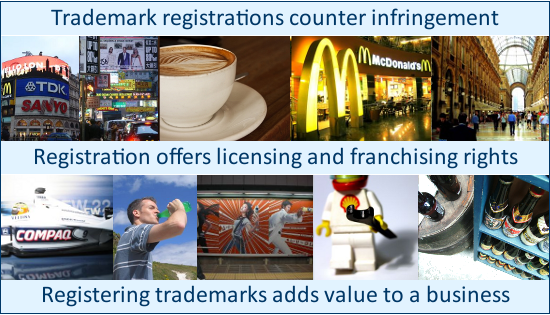
A registered trademark is one of the most valuable and cost-effective forms of intellectual property protection available to a business. Unlike copyright, which arises automatically, trademark protection must be actively obtained through registration.
- Exclusive rights. Registration gives you the exclusive right to use your trademark in the UK (or EU) in relation to the goods and services for which it is registered. Unauthorised use by a competitor becomes an actionable infringement.
- Deterrent effect. A registered trademark appears in official registry searches carried out by other businesses and their solicitors, discouraging others from adopting similar branding.
- Ease of enforcement. A registered trademark is far easier and less expensive to enforce than an unregistered mark through the common law remedy of passing off, which requires extensive evidence of goodwill and reputation.
- Commercial value. Registered trademarks are legal property. They can be licensed to third parties, used as security for borrowing, and transferred on the sale of a business. A strong trademark portfolio is a genuine balance sheet asset.
- Customs protection. Registered trademark owners can record rights with border agencies to enable the seizure of counterfeit goods at ports of entry.
- Domain name disputes. A registered trademark substantially strengthens your position in disputes over infringing domain names under Nominet (for .uk domains) and WIPO arbitration (for gTLDs).
- Online marketplace protection. Amazon Brand Registry, eBay VeRO and similar brand protection programmes require a registered trademark. Registration is often essential for businesses selling online.

How to Register a Trademark in the UK: Step by Step
The process of registering a trademark in the UK involves several distinct stages. Understanding each stage helps businesses plan effectively and avoid costly delays or errors.
- Initial Trademarks Advice and Strategy. Before filing, consider what you want to protect — a word, logo or colour combination — and in which markets you operate. We advise on scope of protection, class selection, and whether EU and international filings should proceed in parallel.
- Trademark Clearance Searches. We conduct comprehensive clearance searches of the UKIPO register and, where relevant, the EUIPO register and international databases. Identifying conflicts early avoids the cost of filing an application that is unlikely to succeed, and the potential liability of infringing an earlier trademark.
- Preparation and Filing. We prepare and file the trademark application with the UKIPO, specifying the mark and classes. We file online wherever possible to take advantage of the lower official fee and provide a fixed-fee quotation at this stage.
- UKIPO Examination. The UKIPO examines the application for distinctiveness, descriptiveness, and conflicts with earlier registered trademarks. If the examiner raises an objection, we respond on your behalf — for example by submitting evidence of acquired distinctiveness or amending the specification of goods and services.
- Publication in the Trade Marks Journal. If the application passes examination, it is published in the UKIPO Trade Marks Journal. This opens a two-month window during which third parties may file a notice of opposition.
- Opposition Proceedings (if any). If a third party opposes the trademark application, formal proceedings commence before the UKIPO involving exchange of evidence and legal submissions. We represent applicants in opposition proceedings and seek settlement where appropriate.
- Registration. If no opposition is filed, or any opposition is resolved, the trademark proceeds to registration. The UKIPO issues a certificate of trademark registration. The registration takes effect from the original application filing date.
- Post-Registration: Trademark Renewal and Enforcement. A UK registered trademark lasts 10 years from the application date and can be renewed indefinitely. A mark not used for a continuous period of five years becomes vulnerable to revocation on non-use grounds. We advise on maintaining and enforcing rights following tradmark registration.
How Long Does Trademark Registration Take?
The time required depends on the jurisdiction and whether any objections or opposition arise.
| Jurisdiction | Registry | Straightforward Application | With Objection or Opposition |
|---|---|---|---|
| United Kingdom | UKIPO | 3–4 months | 12–24+ months |
| European Union | EUIPO | 4–6 months | 12–24+ months |
| International (Madrid) | WIPO / national offices | 12–18 months | 18–36+ months |
| United States | USPTO | 12–18 months | 24+ months |
Planning ahead matters. Trademark rights take effect from the date of the original application, not the date of registration — so filing promptly is always in a business’s interest.
How Much Does Trademark Registration Cost in the UK and the EU?
Trademark registration costs fall into two categories: official fees payable to the relevant registry, and professional legal fees. We provide transparent cost estimates at the outset of every matter.
UKIPO Official Fees (UK Trademark Applications)
| Application Type | First Class | Each Additional Class |
|---|---|---|
| Online application (TM3) | £205 | £60 |
| Paper application | £250 | £60 |
| Renewal (every 10 years) | £245 | £60 |
EUIPO Official Fees (EU Trademark Applications)
| Application Type | First Class | Second Class | Each Additional Class |
|---|---|---|---|
| Online application (EUTM) | €850 | €50 | €150 |
Professional Legal Fees
Our professional fees for a straightforward UK trademark application — covering clearance searches, preparation and filing, advice on class selection and application monitoring — are agreed as a fixed fee at the outset. Where objections or opposition proceedings arise, updated cost estimates are provided before further work is undertaken.
Fixed fees where possible. We provide fixed-fee options for straightforward UK and EU trademark applications. Contact us for a cost estimate tailored to your requirements.
Trademark Classes Explained: The Nice Classification
Trademark protection is granted in specific categories under the Nice Classification — an international system of 45 classes (34 covering goods, 11 covering services). You must specify the classes that accurately describe what your business offers. Your trademark is only protected within those registered classes.
Filing in too few classes leaves your brand unprotected in important areas. Filing in too many without genuine use intention can expose the registration to cancellation on non-use grounds after five years.
| Class | Category | Typical Goods or Services | Common Sectors |
|---|---|---|---|
| Class 9 | Goods | Software, mobile apps, electronic devices, downloadable content, computers | Technology, SaaS, gaming, fintech |
| Class 16 | Goods | Printed publications, stationery, books, packaging materials | Publishing, media, education |
| Class 25 | Goods | Clothing, footwear, headgear | Fashion, retail, sportswear, lifestyle |
| Class 29 | Goods | Meat, fish, dairy products, processed and preserved foods | Food production, FMCG, hospitality |
| Class 30 | Goods | Coffee, tea, flour, bread, confectionery, condiments, sauces | Food and drink, hospitality, retail |
| Class 32 | Goods | Beer, mineral waters, soft drinks, fruit juices | Brewing, drinks manufacturing, hospitality |
| Class 33 | Goods | Alcoholic beverages (except beer), wines, spirits, liqueurs | Distilling, wine production, hospitality |
| Class 35 | Services | Retail services, business management, advertising, marketing | Retail, e-commerce, consultancy |
| Class 36 | Services | Financial services, insurance, banking, investment, real estate | Finance, property, insurance |
| Class 41 | Services | Education, training, entertainment, sporting events, publishing | Education, sport, media, events |
| Class 42 | Services | IT services, software development, cloud services, design services | Technology, software, SaaS |
| Class 44 | Services | Medical services, veterinary services, healthcare, beauty treatments | Healthcare, dental, pharmaceutical, beauty |
| Class 45 | Services | Legal services, personal security, funeral services | Legal, security, personal services |
What Can Be Registered as a Trademark?
The Trade Marks Act 1994 permits registration of any sign capable of being represented clearly on the register and capable of distinguishing the goods or services of one business from those of another. The mark must be distinctive — it must not simply describe the goods or services it is applied to.
- Words — business names, product names, slogans and taglines
- Logos and devices — stylised letters, graphic symbols and figurative marks
- Combined marks — word and logo elements together in a single mark
- Colours — single or combined colours where they have acquired distinctiveness through use (for example, Cadbury purple or Tiffany blue)
- Shapes — three-dimensional shapes of products or packaging (subject to exclusions for functional shapes)
- Sounds — distinctive audio identifiers such as jingles or signature sounds
- Position marks — the specific position in which a sign is applied to a product (for example, the Louboutin red sole)
Non-traditional marks such as colours, shapes and sounds face a higher bar to registration. We advise on the evidence required to support such applications.
UK, EU and International Trademark Registration
UK Trademark Registration (UKIPO)
UK trademark registration is managed by the UK Intellectual Property Office (UKIPO), based in Newport, Wales. A UK registered trademark provides protection throughout England, Scotland, Wales and Northern Ireland. It does not extend to the Republic of Ireland or to any EU member states.
EU Trademark Registration (EUIPO)
An EU trademark (EUTM) is registered with the EUIPO in Alicante, Spain and provides protection across all 27 EU member states from a single application. The EUIPO applies a unitary system — a mark is either registered across the whole EU or not at all. A EUTM no longer covers the United Kingdom following Brexit.
Post-Brexit: What Changed on 1 January 2021?
From 1 January 2021, UK and EU trademarks became entirely separate and independent rights. The key consequences are:
- New applications: Businesses wishing to protect a trademark in both the UK and the EU must now file separately with both the UKIPO and the EUIPO. A single EU trademark no longer provides UK protection.
- Existing EUTMs at exit day: EU trademarks registered or applied for before 1 January 2021 were automatically cloned into equivalent UK registered trademarks known as “comparable trademarks (EU)”. Owners should verify that their comparable UK marks remain correctly maintained and that renewal deadlines are managed.
- EU pending applications: Applications pending on exit day were given a nine-month window to file a corresponding UK application claiming the EUTM priority date.
- UK-based businesses applying for EU marks: UK businesses can still apply for and hold EU trademarks through the EUIPO, and no longer need an EU-based representative for applications.
Post-Brexit action point: If your business held EU trademarks converted to comparable UK marks on Brexit, review your UK portfolio to confirm marks are correctly recorded, renewal deadlines are managed, and use requirements are met.
International Trademark Registration: The Madrid Protocol
The Madrid Protocol is an international treaty administered by WIPO that allows trademark owners to seek protection in over 130 countries through a single international application, filed via the UKIPO or EUIPO. It offers significant cost and administrative advantages — one application, one set of fees, one renewal process.
Each designated country examines the application under its own national law, so objections in individual countries can still arise and must be addressed in those jurisdictions.
Direct National Filings
For businesses requiring protection in jurisdictions not covered by the Madrid Protocol, or where direct filing is strategically preferable, we work with specialist trademark attorneys worldwide.
We regularly advise on filings in the United States (USPTO), China (CNIPA), the UAE, Australia, Canada and across the Asia-Pacific region.
RightGuard® — Our Dedicated Trademark Filing Service
Humphreys & Co. operate RightGuard®, a dedicated trademark registration and brand protection portal providing clients with a streamlined route to filing UK and international trademark applications, with specialist solicitor oversight throughout the process.
Independent Recognition: Legal 500 and Chambers 2026
Humphreys & Co. are independently recommended for intellectual property and trademark work in both leading UK legal directories for 2026.
Recommended for its fierce dedication and tireless work ethic, the specialist team at Humphreys & Co. fields particularly strong expertise in IP litigation and trademark prosecution. The practice is helmed by longstanding IP expert Robert Humphreys, working alongside the very knowledgeable Tristan Morse and Ruth Annand.
Legal 500 United Kingdom 2026 — Intellectual Property
Their expertise in intellectual property, combined with their extensive network, enables them to manage cases with strength and precision.
Chambers Guide 2026 — Intellectual Property
Our Trademark Team
Robert Humphreys
Principal — Trademark & IP Specialist
Longstanding IP expert (Legal 500 2026)
Tristan Morse
Trademark Solicitor
“Very knowledgeable” (Legal 500 2026)
Professor Ruth Annand
Trademark Consultant
Recipient of prestigious INTA trademark award
Why Choose Humphreys & Co. as Your Trademark Solicitors?
We are a niche commercial law firm established in 1986 by partners from City of London law firms. Trademark registration and intellectual property disputes have been a cornerstone of our practice for over 35 years.
- Genuine specialist expertise. Legal 500 and Chambers-recommended solicitors with decades of experience in trademark prosecution and IP litigation — not generalists who occasionally handle trademarks.
- INTA member firm. Member of the International Trademark Association, with over 5,500 member organisations in more than 180 countries.
- Full-service IP practice. Trademark registration combined with expertise in infringement, passing off, copyright and design rights — enforcement capability sits within the same team.
- International network. An established network of specialist trademark practitioners for efficient management of international portfolios, with a single point of contact for clients.
- Fixed fees and transparency. Fixed-fee quotations for straightforward applications, with clear cost updates before any additional work is undertaken.
- Nationally and internationally active. , we act for clients across the UK, EU and internationally.
- Independently recommended since the mid-1980s. Listed in Chambers and Legal 500 every year since the first edition of those directories — a track record spanning four decades.
Frequently Asked Questions: Trade Mark Registration
➤Do I need a solicitor to register a trade mark in the UK?
You can apply directly to the UKIPO without a solicitor, but legal advice significantly reduces the risks of refusal, incorrect class selection and opposition proceedings. Errors at the application stage can be difficult and costly to correct. A specialist trade mark solicitor will carry out clearance searches, advise on the best filing strategy and handle any objections or opposition that arise.
➤Can I register a trade mark for a business name or company name?
Yes. Business names and company names can be registered as trade marks, provided they are distinctive and do not conflict with earlier registered marks. A company name registered at Companies House does not give you trade mark rights — these are entirely separate processes. Trade mark registration through the UKIPO is necessary to obtain exclusive rights to use your name as a brand identifier in relation to goods and services.
➤What are trade mark classes and which ones do I need?
Trade mark protection is granted in specific classes under the Nice Classification system (45 classes in total). You must select the classes that accurately describe what your business provides. Common classes include Class 9 (software, electronics), Class 25 (clothing), Class 35 (retail and business services) and Class 41 (education and entertainment). Selecting too few classes leaves areas of your business unprotected; selecting too many without genuine use intention can expose the registration to cancellation proceedings.
➤How much does trade mark registration cost in the UK?
UKIPO official fees start at £170 for an online application covering one class, with £50 for each additional class. Legal fees depend on the complexity of the application, the number of classes and whether objections or opposition arise. We provide fixed-fee estimates at the outset. See the costs section above for a full breakdown including EU trade mark fees.
➤How long does trade mark registration take in the UK?
A straightforward UK trade mark application with no objections or opposition typically takes around 3 to 4 months from filing to registration. Where the UKIPO raises an objection, the process commonly takes 6 to 9 months. Where a third party files an opposition, proceedings can take 12 to 24 months or longer. EU trade mark applications through the EUIPO typically take 4 to 6 months for uncontested applications.
➤What happens if the UKIPO objects to my application?
The UKIPO may object if the mark is not sufficiently distinctive, is descriptive of the goods or services, or conflicts with an earlier registered mark. You will be given the opportunity to respond — for example, by providing evidence of acquired distinctiveness, arguing against the examiner’s reasoning, or narrowing the specification of goods and services. We represent clients in UKIPO objection proceedings and have a strong track record of overcoming examiner objections.
➤What happens if someone opposes my trade mark application?
Once published in the UKIPO Trade Marks Journal, third parties have two months to file a notice of opposition. Oppositions are most commonly filed by owners of earlier registered marks alleging a likelihood of confusion. Opposition proceedings involve exchange of evidence and legal arguments and can take 12 to 24 months or longer. We represent both applicants and opponents in UKIPO opposition proceedings.
➤Does a UK trade mark cover the EU after Brexit?
No. Since 1 January 2021, UK and EU trade marks are entirely separate rights with no overlap. A UK registered trade mark provides no protection in EU member states, and an EU trade mark no longer covers the United Kingdom. Businesses needing protection in both territories must hold separate UK and EU registrations. Pre-existing EU trade marks were automatically converted into comparable UK marks on exit day, but all new applications must be filed separately with both registries.
➤What is the Madrid Protocol and how does it work?
The Madrid Protocol is an international treaty administered by WIPO allowing trade mark owners to seek protection in over 130 countries through a single application filed via the UKIPO. Each designated country examines the application under its own national law, so objections in individual countries can still arise. We advise on Madrid Protocol strategy and manage international registrations for UK clients.
➤Can I register a colour, shape or sound as a trade mark?
Yes, in principle. Non-traditional marks including colours, shapes, sounds, gestures and position marks can be registered, but face a higher threshold. The applicant must demonstrate acquired distinctiveness — that consumers recognise the mark as identifying a single commercial source. Well-known examples include the Louboutin red sole and the Cadbury purple. We advise on the prospects of registration for non-traditional marks and the evidence required.
➤What is the difference between ™ and ®?
The ™ symbol can be used by any business to indicate a sign is being used as a trade mark, regardless of whether it is registered. The ® symbol may only be used once a trade mark has been formally registered with the UKIPO. Using the ® symbol in relation to an unregistered mark is a criminal offence under section 95 of the Trade Marks Act 1994. We advise on the correct use of trade mark symbols as part of our registration service.
➤How long does a UK registered trade mark last?
A UK registered trade mark lasts for 10 years from the date of application and may be renewed indefinitely in further 10-year periods. A mark not renewed will be removed from the register. A mark not put to genuine use in the UK for a continuous period of five years becomes vulnerable to revocation on non-use grounds. We advise clients on renewal deadlines and maintaining the validity of their registrations.
➤What is passing off and how does it differ from trade mark infringement?
Passing off is a common law remedy protecting unregistered trade marks and business goodwill. The claimant must establish goodwill, a misrepresentation by the defendant likely to deceive the public, and damage as a result. Trade mark infringement is a statutory remedy available only to owners of registered trade marks. Registration substantially simplifies enforcement — an infringement claim does not require proof of goodwill or damage in the same way. This is one of the most compelling practical reasons to register.
Speak to a Trademark Registration Solicitor
If you need advice on registering a trademark in the UK, EU or internationally, contact our commercial team for a clear, no-obligation discussion. Fixed-fee quotations are available for straightforward applications.
Material on this page is provided for general informational purposes and does not constitute legal advice. For advice specific to your circumstances, please contact a qualified solicitor. Humphreys & Co. Solicitors are authorised and regulated by the Solicitors Regulation Authority under no. 62944.
Related Legal Services
- Trade Mark Infringement Claims — Enforcing your registered trade mark rights against infringing third parties
- Passing Off: Unregistered Trade Mark Protection — Common law remedies for unregistered brand rights
- Design Registration and Infringement — Protecting the appearance of products and packaging
- Copyright Infringement and Licensing — Protection for creative works and content
- Intellectual Property: Overview — Full range of IP services
- Confidentiality and Trade Secrets — Protecting commercially sensitive information