
Trademark Infringement Solicitors
We are trademark infringement specialists advising businesses on enforcing and defending registered trademark rights in the UK, the EU and worldwide.
Our specialist trademark infringement lawyers act for claimants and defendants in High Court and IPEC litigation, passing off proceedings, and multi-jurisdictional brand enforcement disputes.
We advise on every aspect of trademark disputes, from the initial assessment of whether infringement has occurred, through pre-action correspondence and interim injunction applications, to full High Court or IPEC proceedings.
We provide trademark infringement advice to businesses of all sizes across the UK and internationally, from start-ups protecting a new brand to established companies with complex multi-jurisdictional portfolios.
Whether you are a trademark owner seeking to enforce your rights, or a business that has received a cease and desist letter or infringement proceedings, our solicitors provide clear, commercially focused advice to protect your interests.
Our commercial team also advises on wider commercial legal services for businesses.
Humphreys & Co. advise businesses throughout the UK on trademark infringement, passing off and brand protection disputes.
Trademark infringement services UK
Our trademark infringement solicitors provide a complete service for businesses involved in tradeise on all stages of a trademark infringement dispute, including assessment of the strength of a claim or defence, pre-action correspondence, applications for urgent interim relief, litigation strategy and settlement negotiations.
We act in proceedings before the High Court (Intellectual Property List, Business and Property Courts) and the Intellectual Property Enterprise Court (IPEC), as well as in opposition and cancellation proceedings before the UK Intellectual Property Office (UKIPO) and the European Union Intellectual Property Office (EUIPO).
Our approach ensures that enforcement action is proportionate, commercially effective and aligned with your wider business strategy.
Why choose Humphreys & Co.?
Our trademark infringement solicitors advise businesses across the UK on protecting and enforcing valuable trademark rights.
Our team also advises on trademark registration, passing off claims and wider intellectual property litigation for UK and international clients.
Why choose our trademark infringement solicitors?
We provide clear, commercially focused advice, practical litigation strategies, and experienced representation in infringement proceedings, passing off claims and opposition matters.
We are experienced in acting on both sides of trademark disputes, whether pursuing infringement claims on behalf of rights holders or defending businesses that have received infringement allegations. Our experience on both sides gives us an accurate assessment of litigation risk from the outset.
What is trademark infringement?
Trademark infringement occurs when a person uses, in the course of trade, a sign that is identical or similar to a registered trademark in relation to identical or similar goods or services, without the consent of the trademark owner, in a way that infringes the exclusive rights conferred by registration.
The Trade Marks Act 1994 sets out the conditions under which infringement arises in the UK. Equivalent provisions apply to EU trademarks under the EU Trade Mark Regulation.
A registered trademark gives its owner the exclusive right to use the mark in relation to the goods or services for which it is registered. Any use by a third party that falls within the scope of those exclusive rights, without the owner's consent, is an infringement.
Infringement can occur even where there is no deliberate intention to copy or exploit another business's brand. It is not a defence that the infringer was unaware of the registered trademark or did not intend to cause confusion.
Where a trademark is not registered, protection may still be available through the common law action of passing off, which we address separately below.

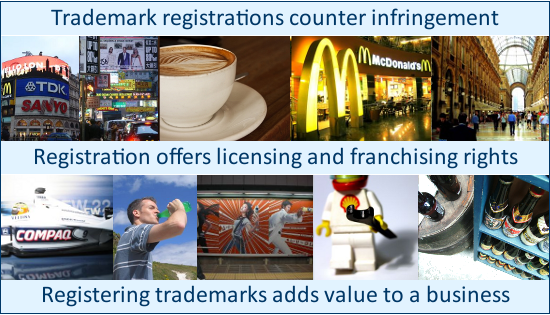
Registered trade marks protect intellectual property rights including brand names, logos and distinctive business identifiers in the UK, EU and internationally.
The 3 types of registered trademark infringement
Under the Trade Marks Act 1994, a defendant infringes a registered UK or EU trademark by using, in the course of trade and without consent, any of the following:
Identical sign for identical goods or services
Where the defendant uses a sign that is identical to the registered trademark in relation to goods or services that are identical to those for which the mark is registered. In these cases, infringement is established without the need to demonstrate any likelihood of confusion.
Identical or similar sign for identical or similar goods or services — likelihood of confusion
Where the defendant uses a sign identical to the registered trademark for similar goods or services, or a sign similar to the registered mark for identical or similar goods or services, giving rise to a likelihood of confusion on the part of the public. The likelihood of confusion includes the likelihood of association between the sign and the trademark.
Identical or similar sign for any goods — trademark with a reputation
Where the registered trademark has a reputation in the UK and the defendant uses an identical or similar sign, even in relation to dissimilar goods or services, and that use without due cause takes unfair advantage of, or is detrimental to, the distinctive character or repute of the trademark. This provision protects well-known and famous marks from dilution or tarnishment even outside their registered classes.
We advise trademark owners and defendants on all three forms of infringement, including cases involving marks with a reputation where the scope of protection extends beyond the registered classes.
What constitutes infringing use?
To amount to infringement, use of the sign must be in the course of trade. This is broadly interpreted and covers most commercial uses of a sign in a business context. Infringing use includes use of the sign:
- on goods or their packaging;
- in advertising, marketing materials and promotional communications;
- on business papers, invoices and correspondence;
- on websites and in domain names;
- in social media and online content;
- as a keyword in paid search advertising such as Google Ads;
- in import and export of goods bearing the sign; and
- in any other way that affects the functions of the trademark.
Use of a sign as a company name, trading name or business identifier can also constitute infringement where it falls within the scope of an earlier registered trademark.
The likelihood of confusion test
Where infringement is alleged on the basis of a likelihood of confusion, the court assesses the question globally, taking into account all relevant factors.
The key factors in the likelihood of confusion assessment include:
- The similarity of the marks — assessed visually, aurally and conceptually, taking into account the overall impression and the distinctive and dominant elements of each mark.
- The similarity of the goods or services — assessed by reference to their nature, purpose, method of use, whether they are in competition with or complementary to each other, and their trade channels.
- The distinctiveness of the earlier mark — marks with a high degree of inherent or acquired distinctiveness enjoy broader protection than marks that are weak or descriptive.
- The perception of the average consumer — the average consumer of the goods or services in question, who is reasonably well informed, observant and circumspect.
- The interdependence of factors — a lesser degree of similarity between the marks may be offset by a greater degree of similarity between the goods or services, and vice versa.
We advise businesses on the strength of their position on the likelihood of confusion in both enforcement and defence contexts, drawing on extensive experience of trademark litigation in the UK and before the EUIPO.

Well-known trade marks with a reputation enjoy extended protection under the Trade Marks Act 1994, including against use on dissimilar goods and services.
Trademarks with a reputation
Registered trademarks that have acquired a reputation in the UK or the EU enjoy an extended scope of protection under the Trade Marks Act 1994 and the EU Trade Mark Regulations.
A trademark has a reputation for these purposes where it is known to a significant part of the relevant public. The mark does not need to be a household name; it is sufficient that it is known within a particular sector or geographic area.
Where a mark has a reputation, the owner can prevent the use of an identical or similar sign even in relation to dissimilar goods or services, provided that the defendant's use without due cause takes unfair advantage of, or is detrimental to, the distinctive character or the repute of the mark. This extended protection covers:
- Dilution: use that erodes the distinctive character of a famous mark by blurring its uniqueness.
- Tarnishment: use that damages the reputation of a mark by associating it with inferior, unseemly or objectionable goods or services.
- Free-riding: use that takes unfair advantage of the reputation or distinctive character of the mark to obtain a commercial benefit without paying for it.
Passing off and unregistered trademark protection
Where a trademark is not registered, or where the registered trademark does not cover all relevant goods or services, protection may be available through the common law action of passing off.
Passing off protects the goodwill and reputation that a business has built up in its name, brand, get-up or other business identifier, even in the absence of a registered trademark.
Passing off claims frequently arise alongside trademark infringement claims and can provide valuable additional protection for rights holders whose trademark registration is incomplete, or where infringement falls outside the scope of the registered classes.
For a business that has not registered its trademarks, passing off may be the only avenue of protection available. We strongly advise businesses that have not yet registered their trademarks to consider doing so: see our trademark registration solicitors page.
For further information on passing off claims, see our passing off solicitors page.
The 3 elements of a passing off claim
To succeed in a passing off action, a claimant must establish three elements, commonly referred to as the classic trinity:
- Goodwill — The claimant must have goodwill attached to its goods or services in the UK. Goodwill is the attractive force that brings in custom: it is the benefit and advantage of the good name, reputation and connection of a business. Goodwill can attach to a name, a brand, a get-up, a slogan, a logo or any other business identifier.
- Misrepresentation — The defendant must make a misrepresentation to the public that is likely to deceive them into believing that the defendant's goods or services are those of the claimant, or that there is a commercial connection between the two businesses. The misrepresentation need not be deliberate: an innocent misrepresentation is equally actionable.
- Damage — The claimant must suffer, or be likely to suffer, damage to its goodwill as a result of the misrepresentation. Damage may include lost sales, erosion of the distinctive character of the brand, loss of licensing revenue, or harm to reputation.
All 3 elements must be established. We advise claimants and defendants on passing off claims at every stage, from assessment of the merits through to High Court litigation.
Remedies for trademark infringement
The civil courts have a wide range of remedies available in trademark infringement and passing off proceedings. The appropriate remedies will depend on the facts of the case, the nature of the infringement and the claimant's objectives.
- Injunctions: a court order requiring the defendant to cease infringing use immediately and permanently, or restraining threatened infringement before it begins. Injunctions can be obtained on an interim basis where urgent relief is needed.
- Damages: compensation for the financial loss caused by the infringement, including lost profits, lost licensing fees and other financial losses. Additional damages are available in cases of flagrant infringement.
- Account of profits: an alternative to damages, requiring the defendant to disgorge the profits it made from the infringing activity. Often the more valuable remedy where the infringer has made substantial profits.
- Delivery up or destruction: a court order requiring the defendant to deliver up or destroy infringing goods, packaging and materials bearing the infringing sign.
- Publication of the judgment: an order requiring the defendant to publicise the court's finding — a valuable remedy in cases involving significant reputational damage.
- Costs: the losing party is generally ordered to pay a contribution to the winning party's legal costs, subject to the costs regime of the relevant court.
Criminal liability for trademark infringement
In addition to civil remedies, certain forms of trademark infringement attract criminal liability under the Trade Marks Act 1994.
It is a criminal offence to apply a registered trademark, or a sign likely to be mistaken for it, to goods without the consent of the trademark owner, where the person does so with a view to gain or with intent to cause loss.
Criminal offences also arise in connection with the sale, distribution and possession of infringing goods.
Criminal sanctions include unlimited fines and imprisonment of up to ten years on conviction on indictment. Prosecutions may be brought by Trading Standards, the Police Intellectual Property Crime Unit (PIPCU) or by the trademark owner as a private prosecutor.
Counterfeiting is one of the most serious forms of trademark infringement and can expose businesses and individuals to significant criminal penalties as well as civil liability.
The High Court and IPEC: which court for trademark disputes?
Trademark disputes in England and Wales are heard in one of 2 specialist courts, depending on the complexity and value of the case.
Handles more complex and high-value trademark disputes. Full range of civil remedies including interim injunctions, search orders and freezing orders. No financial cap on damages or costs recovery. More extensive disclosure and expert evidence than IPEC.
Designed to provide a more accessible and cost-effective route to litigation for businesses, particularly SMEs. Costs cap of £60,000 in the multi-track. Damages capped at £500,000. Streamlined procedure and limited disclosure. Cases resolved more quickly than in the High Court.
We advise clients on the most appropriate forum for their trademark dispute, taking into account the value of the claim, the complexity of the issues, the costs implications and the remedies sought.
How to bring a trademark infringement claim
Bringing a trademark infringement claim involves a number of stages. The appropriate steps will depend on the urgency of the situation, the strength of the case and the commercial objectives of the trademark owner.
- Assessment — Assess whether infringement has occurred, including consideration of the validity of the registered trademark, the scope of the registration and the nature of the defendant's use. We advise on the strength of the claim and the most appropriate course of action at the outset.
- Pre-action correspondence — Send a cease and desist letter to the infringer, setting out the basis of the claim, the relief sought and a deadline for compliance. A well-drafted letter can resolve many trademark disputes without litigation.
- Pre-action protocol — Trademark disputes are subject to a general pre-action protocol requiring the parties to exchange information and attempt to resolve the dispute before commencing proceedings.
- Interim injunction application — Where there is an urgent need to stop infringing use immediately, an application for an interim injunction can be made to the court. We advise on the merits and act in urgent hearings.
- Commencement of proceedings — If pre-action steps do not resolve the dispute, a claim form is issued and served. The defendant must file a defence and, where appropriate, a counterclaim for invalidity or revocation of the trademark.
- Case management and disclosure — The court sets a timetable including provision for disclosure of documents, exchange of witness statements and expert evidence where appropriate.
- Trial and judgment — At trial, the court determines whether infringement has occurred and the appropriate remedies. Many trademark disputes settle before trial; we advise on settlement strategy throughout proceedings.
How long does trademark infringement litigation take?
IPEC multi-track proceedings typically reach trial within 12 to 18 months of commencement. High Court proceedings tend to take longer, often 18 to 24 months or more before trial, depending on the issues involved.
Where urgent interim relief is required, an application for an interim injunction can be heard very quickly — sometimes within days of the application being made.
Many trademark disputes are resolved by negotiation or settlement at an early stage, particularly after the issue of a cease and desist letter or following the commencement of proceedings.
Online trademark infringement
Trademark infringement increasingly arises in online contexts. We advise businesses on the full range of online trademark infringement issues, including:
- Keyword advertising: the use of a registered trademark as a keyword in Google Ads or other paid search platforms to direct internet users to a competitor's website.
- Domain name disputes: the registration of a domain name identical or confusingly similar to a registered trademark, resolvable through the courts, the UDRP or Nominet's Dispute Resolution Service (DRS) for .uk domains.
- Online marketplaces: the sale of counterfeit or infringing goods through platforms such as Amazon and eBay. Platform operators may have liability where they play an active role in facilitating infringing sales.
- Social media infringement: the unauthorised use of trademarks in usernames, profile pages, advertising and promotional content on social media platforms.
- Website and e-commerce infringement: use of trademarks in website titles, meta-tags, product descriptions and other online content infringing the rights of the trademark owner.
- App stores and digital platforms: the registration or use of apps, games or digital products under names that infringe registered trademarks.
Counterfeit goods and brand enforcement

Counterfeiting — applying a registered trade mark to goods without the owner's consent — is both a civil wrong and a criminal offence carrying up to ten years' imprisonment.
Counterfeiting is one of the most damaging forms of trademark infringement, causing serious harm through lost sales, damage to brand reputation and erosion of consumer trust.
Brand owners can take a range of steps to combat counterfeiting, including:
- civil proceedings for trademark infringement and injunctive relief;
- applications for search orders and delivery up of infringing goods;
- referrals to Trading Standards and PIPCU for criminal investigation and prosecution;
- border seizure applications through HMRC and UK Border Force;
- online takedown notices to marketplace platforms and hosting providers; and
- intelligence-led enforcement strategies targeting the source of counterfeit goods.
Defending a trademark infringement claim
If your business has received a cease and desist letter alleging trademark infringement, or if proceedings have been commenced against you, it is important to take legal advice promptly. Receiving a claim does not necessarily mean that your business is in the wrong. Defences may include:
- Use of own name: a person may use their own name or address in the course of trade, provided the use is in accordance with honest practices.
- Descriptive use: use of indications concerning the kind, quality, quantity, intended purpose, value or geographical origin of goods or services is permitted where the use is in accordance with honest practices.
- Exhaustion of rights: where goods bearing the trademark have been put on the market in the UK by the trademark owner or with their consent, the owner's right to control further dealings in those goods is exhausted.
- Invalidity of the registered trademark: a defendant can apply to invalidate the claimant's trademark on grounds including lack of distinctiveness, bad faith, deceptiveness or conflict with an earlier mark. If invalidated, there can be no infringement.
- Revocation for non-use: a registered trademark is vulnerable to revocation if it has not been put to genuine use in the UK in the registered classes for a continuous period of 5 years.
- Consent: use of a sign with the express or implied consent of the trademark owner does not constitute infringement.
Trademark invalidity and revocation
Challenging the validity or continued registration of the claimant's trademark is an important defensive strategy in infringement proceedings and can also be pursued proactively by businesses whose activities are restricted by a third party's registered mark.
The trademark should never have been registered. Grounds include: the mark was not distinctive; it was descriptive; it was registered in bad faith; it conflicts with an earlier right; or it is deceptive or contrary to public policy.
The trademark, though validly registered, should be removed from the register. Grounds include: 5 years' non-use in the registered classes; the mark has become generic; or the mark has become misleading as to the nature or origin of the goods.
Invalidity and revocation proceedings can be brought before the UKIPO or the courts. We advise businesses on the prospects of success and act in those proceedings on behalf of both applicants and respondents.
Trademark enforcement strategy
Effective enforcement of trademark rights requires a coordinated, long-term strategy. A reactive approach to individual infringements is rarely sufficient to protect a valuable brand. We advise clients on comprehensive trademark enforcement strategies, which may include:
- Trademark watching services: monitoring new trademark applications at the UKIPO and EUIPO that may conflict with your registered marks, enabling timely opposition before a competing mark achieves registration.
- Market monitoring: monitoring the marketplace, online platforms and social media for infringing use of your trademarks and brand identifiers.
- Enforcement correspondence: issuing cease and desist letters and follow-up correspondence to address infringements efficiently and cost-effectively.
- Opposition proceedings: opposing the registration of conflicting trademarks before the UKIPO, EUIPO or other national registries worldwide.
- Litigation: bringing infringement proceedings in the High Court or IPEC where necessary to obtain injunctions, damages and other remedies.
- Customs recordal: recording your trademarks with HMRC and UK Border Force to enable the seizure of counterfeit goods at the border.
- Licensing strategy: advising on trademark licensing arrangements that protect the value of your brand while enabling commercial exploitation of your intellectual property.
EU and international trademark infringement
Following the UK's departure from the European Union, EU trademarks no longer have effect in the UK. UK and EU trademarks are now separate rights, and infringement must be pursued in the relevant jurisdiction.
For infringement of EU trademarks, proceedings can be brought before national courts in EU member states that have been designated as EU trademark courts, or before the courts of the member state where the infringement occurred or the defendant is domiciled.
We advise UK businesses on enforcing their trademark rights in the EU and internationally, working with our network of trusted correspondent firms in jurisdictions worldwide, including multi-jurisdictional enforcement strategies, border seizure applications and online takedown procedures.
We also advise on trademark registration in the EU and internationally: see our trademark registration solicitors page.
Legal 500 2026
Recommended for its 'fierce dedication and tireless work ethic', the specialist team at Humphreys & Co. fields particularly strong expertise in IP litigation and trademark prosecution.
The practice is helmed by longstanding IP expert Robert Humphreys, working alongside the 'very knowledgeable' Tristan Morse and Ruth Annand.
Chambers 2026
Their expertise in intellectual property, combined with their extensive network, enables them to manage cases with strength and precision.
What our team is known for
Our team has extensive experience in trademark litigation, prosecution and licensing. We have acted in proceedings before the UK courts, the UKIPO, the EUIPO and the Court of Justice of the European Union.
We advise businesses across a wide range of sectors, including retail, fashion, luxury goods, technology, food and drink, media and financial services, providing strategic advice on the enforcement and defence of trademark rights in the UK and worldwide.
Our trademark infringement solicitors are experienced in advising on high-value and technically complex disputes, as well as in providing practical, cost-effective advice to smaller businesses facing brand infringement for the first time.
We act for both claimants and defendants in trademark infringement and passing off proceedings, and our experience on both sides of disputes gives us a clear-sighted view of litigation risk and the prospects of any given case.
What damages are available for trademark infringement?
- Lost profits: the profits the claimant would have made on sales diverted to the defendant as a result of the infringement.
- Lost licensing income: the royalties the claimant would have received if the defendant had been a licensee paying at an arm's length rate — sometimes known as a reasonable royalty.
- Damage to reputation: compensation for harm to the claimant's brand, goodwill or business reputation caused by the infringing use.
- Additional damages: the court may award additional damages where the infringement is flagrant or where the defendant has benefited significantly from the infringing activity.
As an alternative to damages, a claimant can elect for an account of profits, requiring the defendant to account for and pay over the net profits made from the infringing activity.
An account of profits is often the more valuable remedy where the defendant has generated substantial revenues from infringement.
Trademark infringement services
- Trademark infringement claims in the High Court and IPEC
- Passing off proceedings
- Interim and final injunction applications
- Cease and desist correspondence and pre-action strategy
- Defence of infringement and passing off claims
- Trademark invalidity and revocation proceedings
- Online trademark infringement and counterfeit goods enforcement
- Domain name disputes (UDRP and Nominet DRS)
- Opposition proceedings at the UKIPO and EUIPO
- Multi-jurisdictional trademark enforcement
- Border seizure and customs recordal applications
- Trademark watching and portfolio monitoring
- Trademark licensing and enforcement strategy
- Criminal trademark infringement referrals
We also advise on trademark registration, renewals and brand protection strategy: see our trademark registration solicitors page.
Trademark infringement solicitors: FAQs
A trade mark infringement solicitor advises on whether trade mark infringement has occurred, the strength of a claim or defence, pre-action strategy, litigation in the High Court or IPEC, passing off claims, interim injunction applications, trade mark invalidity and revocation proceedings, and multi-jurisdictional enforcement.
Trade mark infringement is a statutory cause of action under the Trade Marks Act 1994 that requires a registered trade mark. Passing off is a common law action that protects unregistered goodwill and reputation. The two claims frequently overlap and are often brought together. Passing off provides a safety net where the trade mark registration does not cover all relevant goods or services, or where the claimant does not hold a registered trade mark.
No — a claim for trade mark infringement under the Trade Marks Act 1994 requires a registered trade mark. However, you may be able to bring a passing off action if you can establish goodwill, misrepresentation and damage. We strongly recommend registering your trade marks to obtain the stronger, more certain protection that registration provides.
You should take legal advice promptly. Do not ignore the letter. We can advise on the strength of the claim against you, the available defences, the risks of litigation and the most appropriate response. An early, well-considered response can often resolve a dispute without the need for proceedings and at significantly lower cost.
Yes. A defendant can apply to invalidate or revoke the claimant's trade mark as part of its defence. If the trade mark is invalidated, it is treated as though it never existed and there can be no infringement. If revoked for non-use, the registration is cancelled from a specified date.
Costs depend on the complexity of the dispute, the court in which it is heard and whether the matter proceeds to trial. IPEC has a costs cap of £60,000 for multi-track cases. High Court costs are higher and uncapped. We provide clear cost estimates at the outset and advise on proportionate enforcement and defence strategies throughout.
In IPEC multi-track proceedings, the maximum amount that the losing party can be ordered to pay towards the winning party's legal costs is currently £60,000. Damages in IPEC are capped at £500,000. This makes IPEC a more cost-effective forum for trade mark disputes than the High Court, particularly for SMEs.
Yes. Where there is an urgent need to stop infringing use, an application for an interim injunction can be made to the court. The court will consider the balance of convenience and whether damages would be an adequate remedy. We act in urgent interim injunction applications at short notice, including out-of-hours applications where justified.
In certain circumstances, yes. Where a company or trading name is identical or similar to an earlier registered trade mark and its use infringes that mark, the trade mark owner can seek an injunction requiring the defendant to change its name and cease infringing use. There is a limited defence of use of own name, but this is narrowly construed by the courts.
It is possible to bring a trade mark infringement claim without a solicitor, but trade mark litigation is technically complex and the consequences of errors in procedure or strategy can be significant. Legal advice ensures that your claim is assessed properly, proceedings are conducted correctly and your prospects of success are maximised.
Many disputes are resolved at the pre-action stage. IPEC proceedings typically reach trial within 12 to 18 months; High Court proceedings often take longer. Interim injunction applications can be heard within days where urgency is established.
A cease and desist letter is a formal letter sent by or for a trade mark owner to an alleged infringer setting out the nature of the alleged infringement, the rights relied upon and the relief required. It is usually the first step in trade mark enforcement and often resolves disputes without the need for litigation.
The High Court handles more complex and high-value cases with no cap on damages or costs. IPEC is a more accessible and cost-controlled forum, with a costs cap of £60,000 and a damages cap of £500,000, suited to disputes where the value or complexity does not justify High Court proceedings.
No. Intention is not a requirement for civil trade mark infringement. A defendant who inadvertently uses a sign identical or similar to a registered trade mark in the course of trade infringes the mark regardless of their knowledge or intent. Intention may be relevant to the level of damages but it is not a defence to a civil infringement claim.
A UK trade mark registration lasts for ten years from the date of application and can be renewed indefinitely for further periods of ten years on payment of the renewal fee. A trade mark that is not renewed lapses and can no longer be enforced through infringement proceedings.
Related Legal Services
- Trademark Infringement Claims — Enforcing your registered trademark rights against infringing third parties
- Passing Off: Unregistered Trademark Protection — Common law remedies for unregistered brand rights
- Design Registration and Infringement — Protecting the appearance of products and packaging
- Copyright Infringement and Licensing — Protection for creative works and content
- Intellectual Property: Overview — Full range of IP services
- Confidentiality and Trade Secrets — Protecting commercially sensitive information